I spent a magical five days in Scottsdale, AZ for Thanksgiving, with my son and his extended family. His wife, Whitney, Kathy and I took a Friday afternoon excursion to Taliesin West, the western home of Frank Lloyd Wright. From the first words of the audio tour we were on, I learned a great deal more information about this school of architecture and winter home of Frank Lloyd Wright. I will invariably bollocks up said information, so I encourage you to refer to the link above for more accurate information; I’ll share what my take aways were. I’ve had a long infatuation with Frank Lloyd Wright’s architecture, from an early exposure to seeing Fallingwater in Southwestern Pennsylvania, where I grew up, through the eyes of my grandfather who was an architect. I think I was about six or eight when we visited Fallingwater with my grandfather. Here are some pictures from that visit. I’m not sure I ever re-visited it again as a grown up.
My memories of Fallingwater’s allure were about the corner windows, which were glass to glass, creating no visual interruption from the interior to exterior of the house, as well as the smooth river stone floors, and the trillium in the forest around the house. I’ve always related to Wright because of his midwestern origins, and his practical “learning by doing” philosophy that he instilled in his students at both Taliesin and Taliesin West.
Taliesin is Welsh for “shining brow.” This was the first fact and reflective of the positioning of Wright’s complex on the site, not at the top of the site adjacent McDowell Mountains, but nestled so that there is a lovely foreground, middle ground and background. The day of our visit was appropriately tempestuous, which the tour referred to, “tempestuous made” as we stood next to the Prow Pond, the sky dramatic and threatening. Standing there was like standing at the prow of the ship, facing off into the desert, with the mountains behind. Taliesin West was Wright’s winter home and desert laboratory from 1937 until his death in 1959.
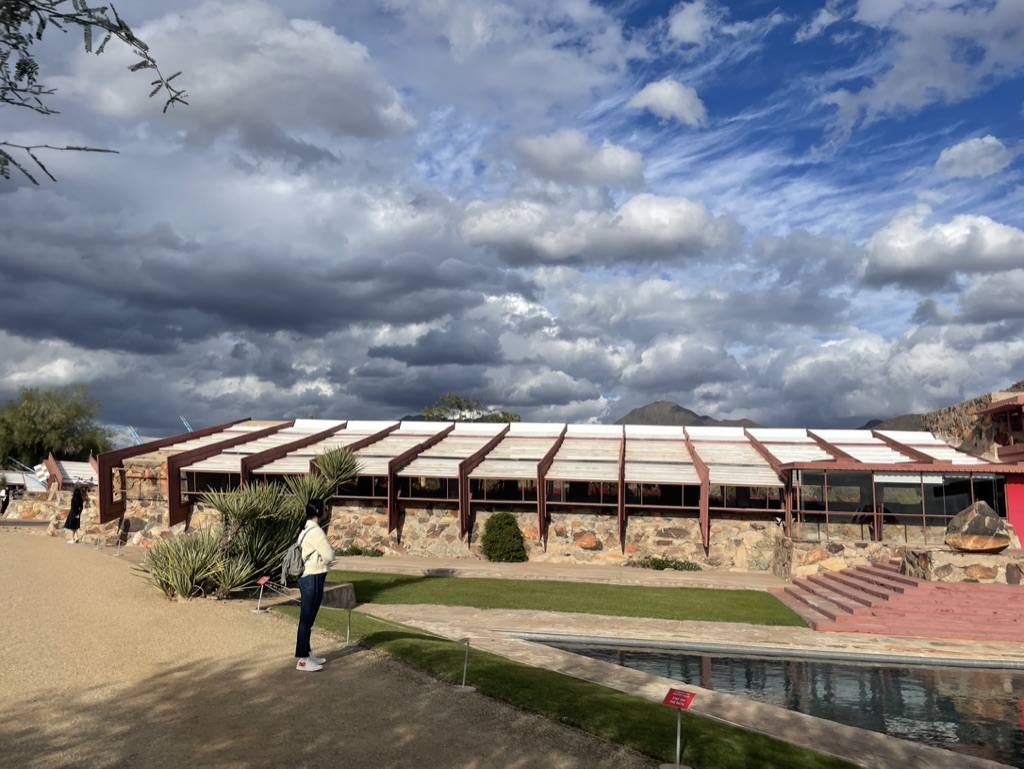
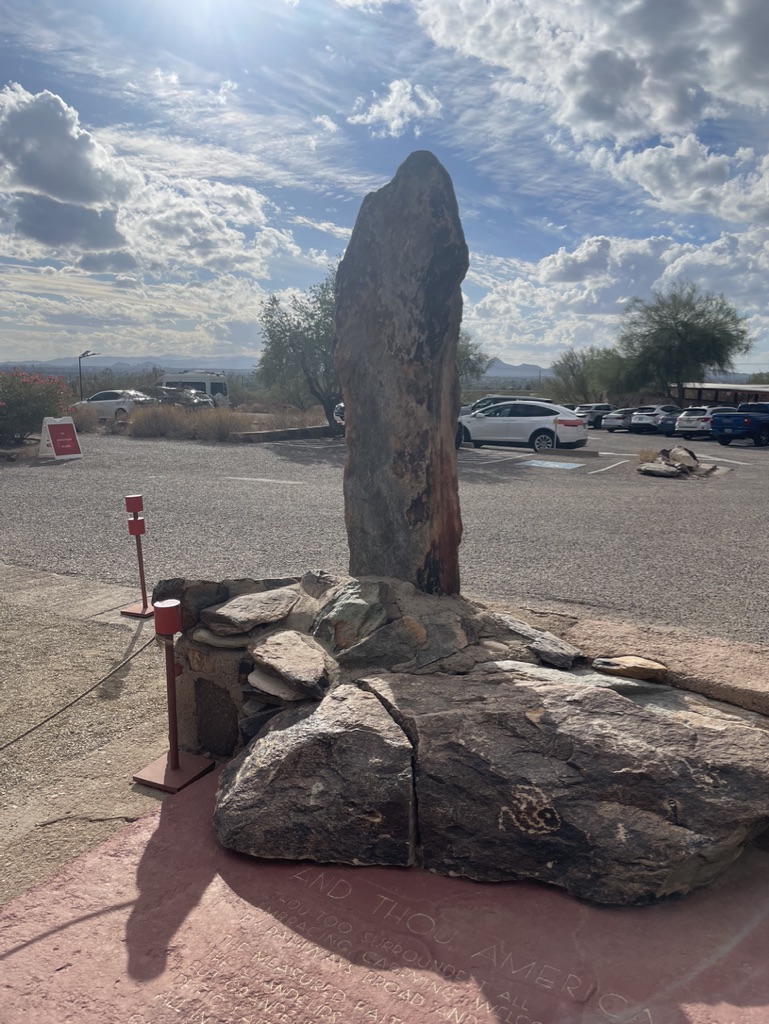

Over the course of the approximately 60-90 minute self-guided audio tour , the guides methodically addressed four tenets of Wright’s architecture: Space, Site, Materials and Democracy. We were able to take our time to observe the various tenets in action as we followed the verbal instructions. Some of the things that impressed me were their care in guiding folks for whom this might be their first experience with an audio tour to use the tool, jettisoning it half way through with a good natured “you’ve got this from here.”
Beginning with several stations outside, we came to appreciate the care with which the site had been chosen, as well as the use of local materials such as the granite embedded in concrete formed by the students using wooden frames to shape the massive walls of the compound. The use of linen fabric as “window” treatment in both Wright’s office and in the drafting studio has the effect of filtering light evenly across the working spaces.
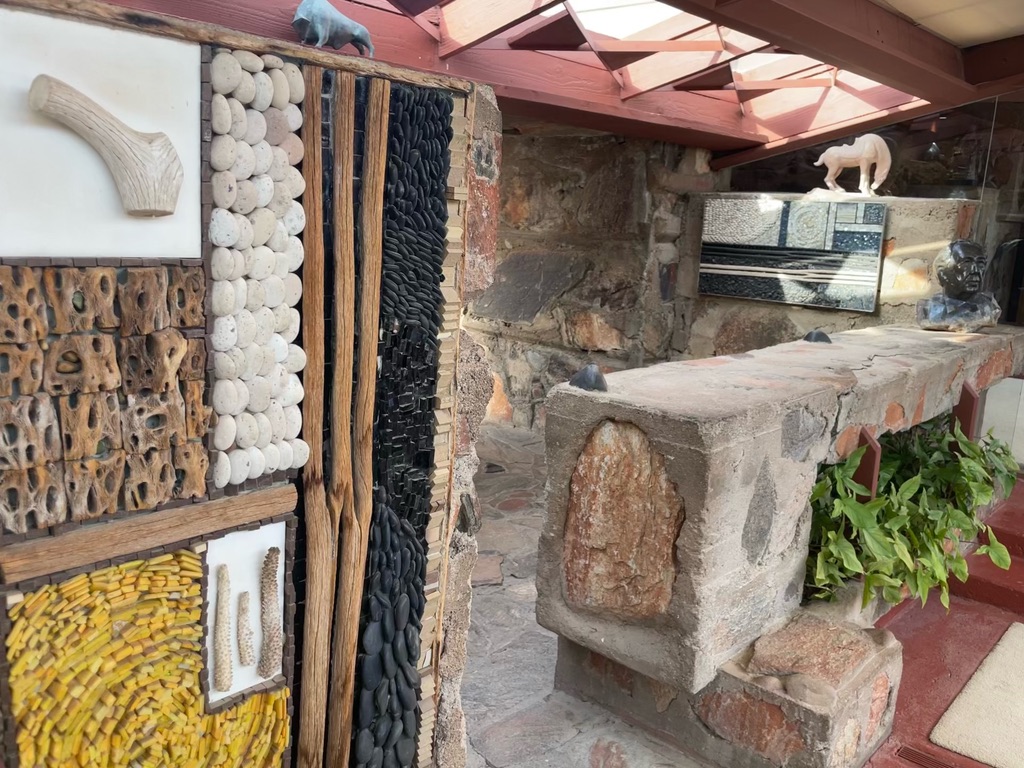
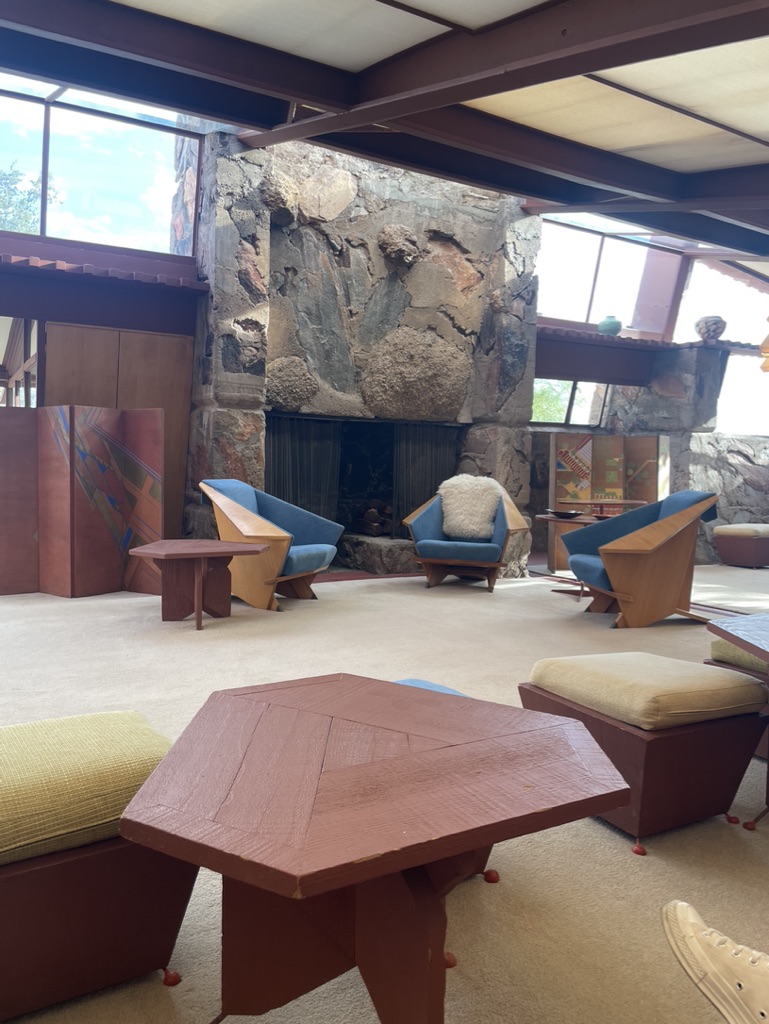

I remembered the Garden Room from my previous visit to Taliesin West (entry seen here), but appreciated the multipurpose antithetical single Victorian purpose of the room as Living Room, Music Room, and Gathering social space for his students. The tour reinforced the idea that for the may years Wright came to the campus he was always making improvements in the spaces: for example, adding glass windows in that space, and reworking sections of the house with his students. Even the furniture was constructed by them, including the “taliesin or origami chairs” each constructed out of one sheet of plywood. The tour reminded us of Wright’s use of compression when entering spaces, and releasing the space after the initial entrance.
The property is punctuated with Chinese Theatrical vignettes, which we were told were placed to indicate a shift in purpose of space, from outdoor to indoor, from work to living, etc. Other chinese influences included a fire breathing dragon in the Breezeway area, which had been a gift to Mrs. Wright in 1959 on the occasion of Wright’s death, and which is plumbed to breathe fire on occasion. There were many other fine Chinese artifactss throughout the tour including a beautiful woven screen in the dining nook.


My favorite part of the tour, unsurprisingly, was a temporary exhibit featuring the work of Georgia O’Keeffe and Frank Lloyd Wright, with stunning photos by Tony Vaccaro, a LIFE Magazine photographer who just passed away at the ripe old age of 100 in December 2022. The installation, set in the center of the house featured several uncharacteristically merry photos of O’Keeffe and noted the importance of music and the southwest to both Wisconsin-born artists. You can see more about the exhibit here, but I found it particularly pleasing, as I’ve been a life-long appreciator of Georgia O’Keeffe’s as well. The two met in 1942 and had an extended correspondence for over twenty years of their lives. The exhibit will be at Taliesin West until June 2024.
Both were born in rural Wisconsin and had careers that took them to big cities – but ultimately, they made homes in the southwest – Wright in Arizona, O’Keeffe in New Mexico.
American Icons – Wright & O’Keeffe

One thing I was sorry our tour of Taliesin West did not include (but there is another Shelters in the Desert tour you can take!) was a walk through the labs of the students who had studied under Wright. The audio tour was full of snippets of Wright’s voice and his encouragement of the students.
We visited the Kiva, or indoor movie/discussion space which was also used for storage when Wright moved his operations to Taliesin. There were examples of recessed lighting, cove and pendant lighting in that space.
Taliesin West is undergoing a major plumbing redo, with the tour describing the minimal plumbing installed in 1939, where interns showered by hose, taking advantage of the hoses thrown over the concrete walls, the water warmed by the sun . They are currently replacing the sewer systems with PVC pipe.
By this point, we had been carefully schooled about space, site, and materials. We made our way to the last structure on the tour, the cabaret space. Wright valued democracy as well –
In a democratic environment the built environment supports the goals of their community.
from the audio tour
The cabaret space provided a space for the entire community where students were encouraged to perform for each other in music, acting, etc. The space was beautifully crafted to provide a stage with stellar accoustics for speakers and singers, and the seating throughout the house provided intimate seating areas where people could share their enjoyment. Needless to say, this was one of my favorite spaces on the tour.


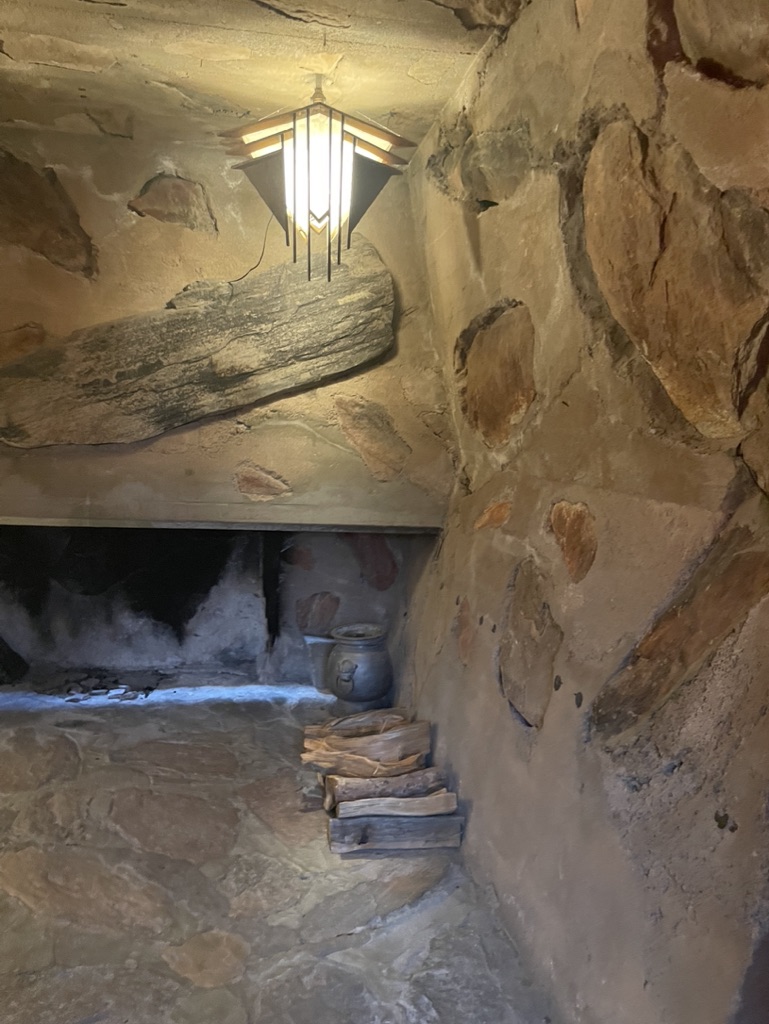

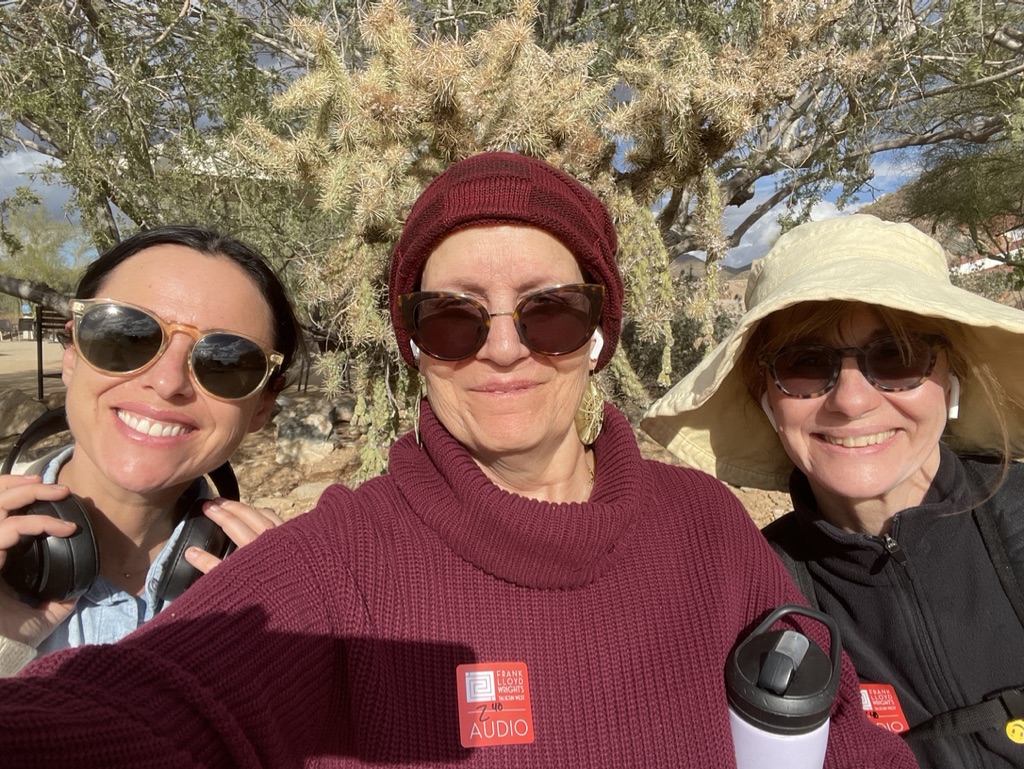
I loved the afternoon spent in the tempestuous Arizona desert admiring the work of Wright and O’Keeffe. Whitney and Kathy and I found many moments of refuge in the natural spaces and materials honed by his students and him. I am so grateful to the foundation for preserving this beautiful space for the next generations.


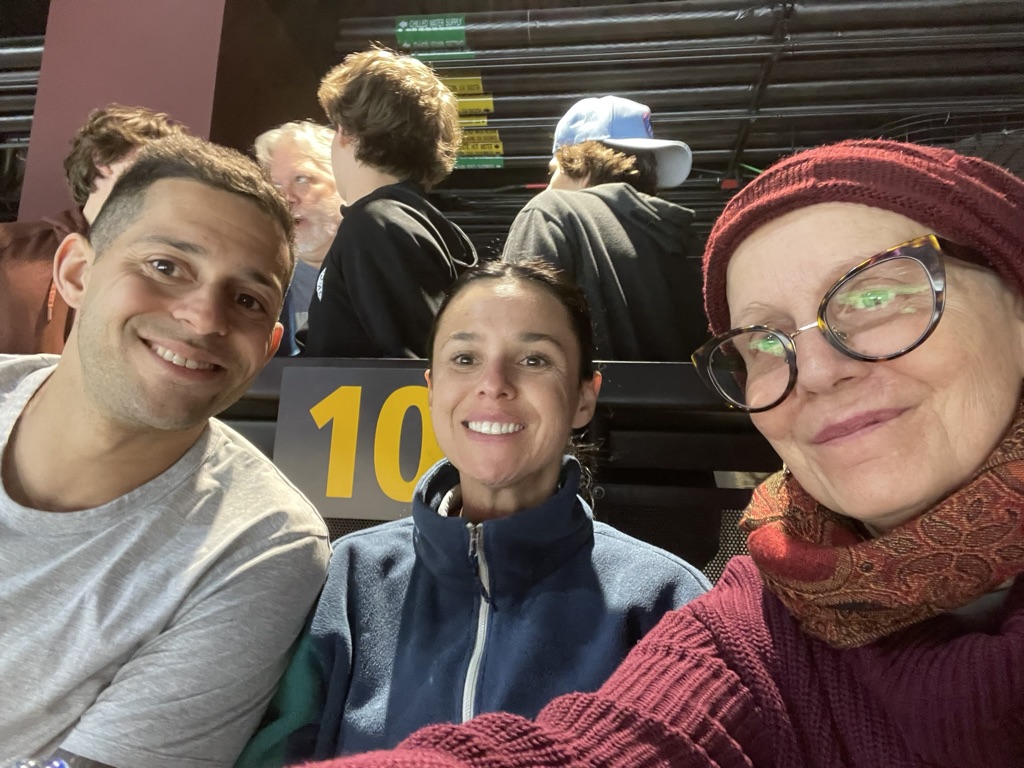
And later that evening, Chris and Whitney and I took in an ASU Division 1 Hockey game at the Mullett Arena on the campus of ASU in Tempe, AZ. We watched as they beat the visiting Providence team in the five minute three on three OT. A little something for everyone!

 lifeinthethe8tre