Somewhere around the year 2000, while inching down the Hollywood Freeway with my young son strapped into the back seat on the way to a babysitter, I had what I can only describe as an epiphany. For years I had been muddling through the logistics of my home life—the school pickups, the rehearsal nights, the impossible arithmetic of two working theater parents—while a few miles away, in a rehearsal hall, I was orchestrating the movements of dozens of artists with serene precision. I had a professional toolkit I used every single day. I had simply never thought to carry it across the threshold of my own front door.
The realization changed how I ran my life. It has since occurred to me that it might change how a good many people run their organizations, too. Because the stage manager sits at a peculiar crossroads—part logistician, part diplomat, part crisis responder—and the discipline that lets a show survive a thousand small catastrophes is, I have come to believe, exactly the discipline most boardrooms are missing.
We rehearse for the bus
There is a phrase every stage manager knows by heart. We leave our calling scripts at the theater each night “in case I get hit by a bus.” It sounds morbid, and it is meant to. The point is that the show cannot be allowed to depend on any single irreplaceable person—least of all the one running it. So we document obsessively: the blocking, the cues, the order of operations, every decision in a form another human being could pick up cold and execute.
Most businesses do the precise opposite. They concentrate critical knowledge in a few heads, congratulate those people on being indispensable, and then discover the true cost of that arrangement the morning someone resigns, falls ill, or simply takes a long-overdue vacation. I have watched theatrical institutions fail at this as well, so I do not say it from a position of superiority. I say it because I have lived the alternative, and the alternative is better.
During the 2019–2020 season at the university where I taught, our production stage manager on a massive three-play repertory fell ill during the final dress rehearsals—almost certainly, in hindsight, with COVID-19, though none of us yet knew to name it. Her freshman assistant stepped into the booth and blind-called the show from the book. The next night, a second freshman did the same for an even more technically demanding production. Were those calls flawless? Of course not; no one can be, with an hour’s notice. But the show went on, both nights, because the work had been documented so that it could go on without its author. The stage manager was mortified to have missed an opening. I told her the truth: she had just handed two students the most valuable training of their lives, and she had done it by building a process that did not require her to be present. That is not a failure of leadership. That is its highest expression.
The decisive question is never whether the leader can perform under pressure. It is whether the work can survive the leader’s absence.
The decisive question is never whether the leader can perform under pressure. It is whether the work can survive the leader’s absence. Cross-train relentlessly. Plan for your own obsolescence. The leaders who cannot bear to be replaceable are, almost without exception, the ones whose departure leaves the deepest holes.
The crisis began long before the crisis
Business writing loves the drama of the decisive moment—the war room, the all-hands, the leader who rises to the occasion. My experience is less cinematic and more useful: the overwhelming majority of crises are simply the late arrival of an oversight that was small and quiet and entirely preventable a day or a week earlier.
I learned this the hard, public way more times than I would like to admit. But the lesson sharpened into method when I began applying the phases of theatrical preproduction to ordinary problems. When my husband’s mobility began to fail and we needed a scooter, I did not panic and improvise. I ran the sequence I had run on a hundred productions. Research: what does the situation actually require? Plan: where is the nearest place to test models, will it fit in the car, where will it charge, can it travel by air? Execute: test-drive it, rehearse the trips to the park, learn to assemble and disassemble it quickly. The same questions a stage manager poses to a director before a rehearsal process ever begins.
The discipline here is anticipatory. A good stage manager spends the calm weeks imagining the failure modes—the actor who arrives jet-lagged and disoriented, the set piece that might injure someone, the elevator that has stranded you before and will strand you again. We do not wait for the emergency to reveal the weakness. We hunt the weakness while there is still time to fix it cheaply.
I think of an organization as a three-legged stool. It is only as stable as its weakest leg. A team can be propped up on very strong legs—each person with a unique skill set and clear responsibility—and still be one resignation away from collapse, because no one ever asked what happens if a leg gets chopped off. The leaders I most admire are the ones who ask that question on a quiet Tuesday, when nothing is wrong, precisely so they never have to ask it in the dark.
Calm is a deliverable
When the genuine emergency does arrive—and it will, no matter how thorough your preparation—the single most important thing a leader provides is not a solution. It is composure.
I have stood in a tech booth as a lead actor failed to appear and failed to call, and I have felt the full sequence of human responses move through me: anger at his irresponsibility, embarrassment that I might have failed to communicate the call, worry that something terrible had befallen him, fear, then relief that he was alive, then—I am not proud of how fast this one came—fear again about whether he could still do the show. Every one of those feelings was real. None of them belonged in the room.
This is perhaps the hardest thing to teach. A stage manager learns that feelings are just feelings; that naming them privately defangs them; and that what the company sees on your face becomes the emotional weather of the entire enterprise. An audience will forgive nearly any technical failure if the people running the show appear unbothered. The same is true of employees, of clients, of investors. Panic broadcasts. So does steadiness. A leader who can metabolize her own alarm and present the room with a calm, working mind is doing real labor, even when it looks like she is doing nothing at all.
An audience will forgive nearly any technical failure if the people running the show appear unbothered. Panic broadcasts. So does steadiness.
The corollary, which I cling to, is that calm is mostly the dividend of preparation. I have rarely felt true terror over a problem I had genuinely rehearsed. The dread lives in the gaps you knew about and chose to ignore.
You cannot improvise your way out of a culture you neglected
Here is the part the heroic-leader literature gets most wrong. It imagines that crises are solved by brilliant individuals making bold calls. In my experience they are solved by teams—and the quality of the team in the emergency is determined entirely by how it was treated in the calm.
I have watched micromanagement and exclusion quietly drain the life out of capable companies. When you cut people out of the larger goals, when you treat them as instruments rather than collaborators, they withdraw—and the loss of a team’s collective mind, heart, and creative spirit weakens both the group and the product in every measurable way. Then the crisis hits, and you reach for that collective intelligence, and discover you spent it long ago.
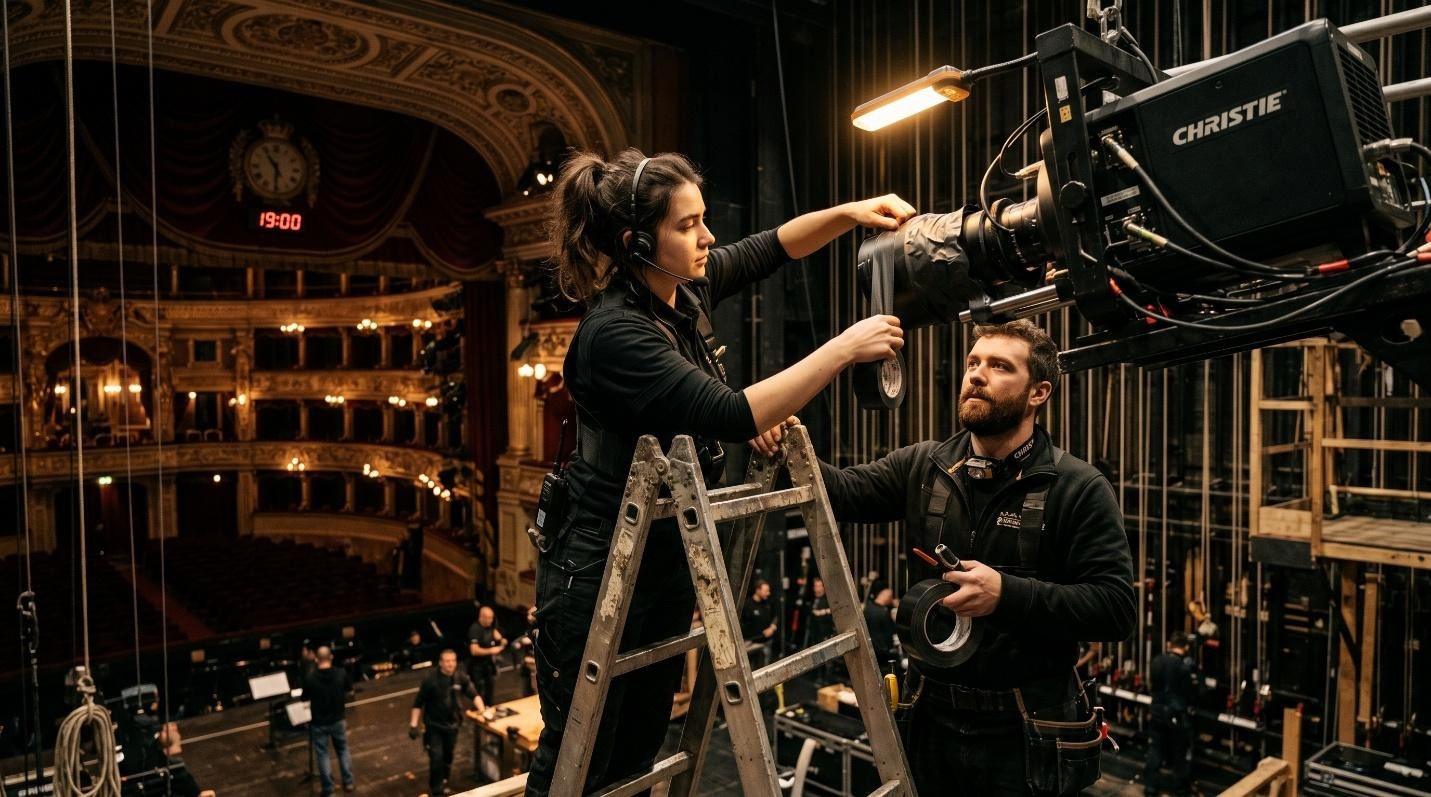
The contrast still amazes me. In a small historic theater in Croatia, with a crew I had never met, a critical piece of projection equipment failed an hour before our final dress. I did not solve it. The house technicians and our video engineer climbed a ladder, removed the broken part, and rebuilt a working substitute out of black wrap and ingenuity. When it functioned, the whole room celebrated, and those technicians were the heroes of the week. None of that was procedural. It was cultural. It happened because, in a handful of ordinary days beforehand, we had eaten dinner together, treated one another as full partners, and assumed we were all in the same boat. The rescue was paid for in advance.
This is the unglamorous truth a stage manager carries from the theater into any room where people work: your crisis response is only as good as the relationships you built before the emergency. The procedures matter. The documentation matters. But the decisive resource, when the lights go out and the clock is running, is a team that trusts you enough to hand you the solution you could never have engineered alone.
The whole of it
So what can a stage manager teach a business leader about navigating catastrophe? Four things, really, none of them complicated and all of them hard.
Document and cross-train as though you might be hit by a bus, because the goal is not to be indispensable but to build something that endures without you. Hunt your weaknesses in the calm, because nearly every disaster is a preventable oversight that simply arrived late. Treat composure as a genuine deliverable, because the room takes its emotional temperature from your face. And invest in your people long before you need them, because the team that saves you in the dark is the one you respected in the light.
Final Thought
I spent more than thirty years with my heart in my mouth, calling complex sequences and absorbing the shock of things gone wrong. What I learned in that booth was not a set of tricks for the bad day; it was a way of working that makes the bad day survivable, and every so often makes it the best teacher you will ever have. A crisis is rarely the test of a leader’s brilliance. It is the audit of everything she built before it arrived—the documentation, the foresight, the composure, the trust. Build those well, in the quiet, and the emergency becomes survivable. Neglect them, and no act of heroism in the moment will save you. The curtain rises regardless of how ready you are. Leadership is simply the work of being ready anyway.
Sources
- logistics — https://www.britannica.com/dictionary/logistics
- threshold — https://dictionary.cambridge.org/us/dictionary/english/threshold
- stage manager — https://www.berklee.edu/careers/roles/stage-manager
- blocking — https://en.wikipedia.org/wiki/Blocking_(stage)
- cues — https://dictionary.cambridge.org/us/dictionary/english/cue
- repertory — https://www.britannica.com/art/repertory-theatre
- COVID-19 — https://www.cdc.gov/covid/about/index.html
- Cross-train — https://www.shrm.org/topics-tools/news/hr-magazine/enhance-hr-effectiveness-cross-training
- corollary — https://dictionary.cambridge.org/us/dictionary/english/corollary
- micromanagement — https://dictionary.apa.org/micromanage
- Croatia — https://www.britannica.com/place/Croatia
- full partners — https://dictionary.apa.org/employee-engagement
- crisis response — https://www.everbridge.com/blog/what-is-crisis-management/
 lifeinthethe8tre
All completely true and should be shared far and wide! Great blog!